




Tuesday, 30 August 2016

Wednesday, 3 August 2016
Procedure Writing - Updated
When we think of the text types we need to teach to our class we first think narratives and persuasive.
We chuck in some poetry, a letter or two and then maybe think about procedures.

I love teaching procedure writing!
It is one of the most hands on and engaging text types and definitely a text type they will see and probably need to write later in life.
It can also be a gateway to teach so many other topics, cooking, measuring, verbs, adverbs, oral instructions and so much more!
Today I am going to share with you some fun lessons I like to do and you can find all the resources you need for them and many more exciting lessons all sequences into a complete unit for all grade levels.
Teach your students to be specific and thorough when writing procedures by getting them to write a procedure for making toast. Then allow them to make the toast following their instructions down to the letter! Oops, they forgot to push the toaster down? Sorry you'll have to have bread. The instructions says to put toast in the toast? Guess they want burnt toast!
It can also be fun to get them to read their instructions to you and you follow them. So when they say put the butter on the toast, pick up the container and put it on the toast. Spread jam over the toast? Lather it on really thick or incredible thin.
It can be a great laugh for everyone and a meaningful lesson.
Warning: The smell of toast cooking in a classroom will make you hungry!
I have also done this lesson with Fairy Bread and it was just as popular!
I have also done this lesson with Fairy Bread and it was just as popular!

Another lesson I love to do is take 4 different procedures for making paper planes and give one each to different group of students. One is an online video tutorial modelling how to make it, another has written instructions with clear pictures, the next a procedure with only words and last is only a picture of the final product. Groups then spend time making their plane. It doesn't take long for a few groups to become frustrated and the video tutorial group to finish. Discuss with students why some had trouble and others didn't and then get the finished students to help the others make a plane.

Sequencing activities are great introduction into procedures as they show students why order is important and encourage the use of signal words such as firstly, secondly etc.
Teaching procedure writing also has a great lot to do with giving verbal instructions. I find barrier games a great introduction into instructions. Students partner up and are separated by a barrier. One partner makes a picture and then must describe their picture to their partner. They can not look at each others pictures until the very end. The closer the pictures the better the instructions and listening.

My barrier games come included in my Procedure Writing Units or you can buy them on TPT.
I have also found it important in the older grades to extend students vocabulary of verbs otherwise you just get put, put, put, put all the time.


Save yourself the time of making your own posters and purchase my Other Words For Verbs on TPT or find it included in Year 5 and 6 Procedure Unit.
To make sure students really know what is expected of them I like to go through the rubric I am going to be marking them against. This rubric is available for FREE by clicking here.
To make sure students really know what is expected of them I like to go through the rubric I am going to be marking them against. This rubric is available for FREE by clicking here.
  |
| Purchase on TPT |
 |
| Purchase on TPT. |
 |
| Purchase on TPT. |
 |
| Purchase on TPT. |

Sunday, 8 May 2016
No Stress NAPLAN Testing

The most important thing during NAPLAN is to to make the students understand that NAPLAN is 4 tests that you do your best in but they are not something to stress over. I explain the format of NAPLAN, that no one is expected to get 100% on it. That it has questions from year levels above theirs. I also tell them that not even I usually get 100% on the test. I tell the students that doing their best will make me proud and that is something they should strive for.
By carefully preparing my students for NAPLAN I have never had any tears or comments of 'I can't do this'. In a split 2/3 class I even had a year 2 student beg me to let them do the test!
Test Strategies
Introduce strategies to students help students cope with the test.
For younger students introduce strategies as a memorable character (see below for suggested names).
Dead Fred- Did not die from a
test
Whinging Whinnie - negative character- gets upset about tests
Careful Cara - Reads the
questions carefully by looking for key words
Naughty Nick -Places a silly
(obviously wrong) answer in each question
Sneaky Sarah - Places two similar
answers in each question to try and trick you
Guessing George - Makes guesses
only when necessary and eliminates first
Recheck Rebecca -Rechecks her
answers at the end


Purchase these posters on Design by Teachers.
Good luck to all students and teachers!
Monday, 2 May 2016
10 Ways to get More out of NAPLAN Week

NAPLAN is an unfortunate part of the education system in Australia. Don't let NAPLAN interrupt a whole week of learning, here is 10 ways to get more out of NAPLAN week this year!
1) Teach testing strategies to impact future (more important) tests. Students need to learn tricks such as eliminating incorrect answers, reading the questions carefully and checking their work. Click here to learn more about how I teach these strategies to students.
2) As the NAPLAN tests don't really matter you can help to promote a fearless attitude towards tests. A student who doesn't stress about the NAPLAN tests will be less likely to stress about HSC/TEE or university exams. Last year I had a split grade 2/3 class and I had a year 2 student BEG me to sit NAPLAN. He had no fear towards the test as I had taught my students to see the fun in it!
3) Use NAPLAN as a springboard for writing activities like writing a letter to the next years group of year 3/5s telling them about the experience and any tips they might have.
4) At the conclusion of the week reflect on the experience with a PMI (Plus. Minus and Interesting). Reflective practices are important to have to get the most out of learning experiences and it helps students debrief if they have found the week difficult.
5) Have your students delve deeper into NAPLAN with a comprehension text or research report into NAPLAN including why we have it and its history. This helps students understand why the tests shouldn't matter to them and practices reading and research skills.
6) Learn about poetry types by getting students to write a poem about their feelings towards NAPLAN through a haiku or cinquain. This is also great for students to see they share the same emotions as other students.
7) Incorporate maths into the week by graphing the experiences. What emotions are students feeling before the test? After the test? How do they compare? How did they find the test? easy, medium, hard?
8) As a final persuasive writing practice session or a chance to use their new skills if the writing text type is instead a narrative get the students to write whether or not we should have national testing.
9) On the opposite side, if you would like them to do a narrative text then ask them to come up with the craziest reason to get out of a NAPLAN test. This is can really lighten the mood of the week and give everyone a laugh!
10) After the tests each day the students are not up for large content lessons so take the excuse and play games with the students and bond with them! When students think of NAPLAN week have them look back fondly rather then negatively.
I wish you and your students all the luck in NAPLAN next week. Make sure to frequently remind students it is only four tests that show what the students are capable of on that day, the results do not mean anything in the long run,
To read more about my preparation for NAPLAN click here.
Saturday, 16 April 2016
COMPETITION TIME!!!!
Head over to my Mrs Amy 123 on Facebook to WIN your choice of $30 worth of Mrs Amy123 products! Closes 1st May 2016


Saturday, 26 March 2016
Would you Rather....?
Would you rather lose the sense of hearing or sight? Live with 100 people or alone? Talk really fast or slow?
Did those questions make you think? Were they fun to answer?
Icebreakers ❄
These can be great for allowing
students to get to know each other as they learn interesting and unusual pieces
of information about each other while being fun. As there are no right or wrong
answers students don’t have to worry about the answers they give.
Brain Breaks 🙏
Posing these questions can be great for breaking up the day or
a lesson. Brain breaks help to get students focused and energised.
Creative Thinking 🌟
These questions promote creative
thinking as students must take many different things into account to make a
choice when often you would rather not do either or would want to do both.
Writing Activities ✏
These questions make great persuasive writing topics and can be used to promote spelling, grammar, handwriting and/or text
structure.
Reading Activities 🔖
Students can read other students
responses or research their answers.
ICT Activities 💻
Get students to research their answers on
the internet or record their responses on an iPad. They can type up their answers, publish their responses or make a PowerPoint.
Speaking and Listening Activities 💋
Students can practise conventions of
speaking and listening by sharing there thoughts with others including formal presentations and debates.
Cooperation Skills 👏
Students can work together to learn from another, work together and support each
other.
Maths Activities 📈
Gathering, recording and presenting data
on preference can be fun
and enlightening.
Fun 😊
Your
students are guaranteed to enjoy all these questions! Here are some activities to try:
Snowball
😊 ❄ 🙏 💋
Present a question to students and have
them record their choice and a brief explanation on a piece of paper. They
scrunch up the paper and stand in a circle. On the teachers signal they throw
it at someone's feet then pick up other balls and continue throwing them until
the teacher says stop. Everyone grabs a ball, unwraps it and one by one reads
what it says to class. This is great for topics where students might be
reluctant to share or uncomfortable.
Elevator
Speech 😊 🙏 🌟 💋
Present a question to students and allow
them 1 minute to talk
about their choice and the reasoning
behind it. This can be in
front of a whole class to develop oral
presentation skills
or in pairs or small groups to begin to
develop speaking
confidence or persuasive arguments.
If this sounds like something you want to do in your class check out my Would You Rather Activity Pack. It contains 40 question posters and 25 activity ideas!
Get it on Teachers Pay Teachers or Designed by Teachers


Saturday, 6 February 2016
Valentine's Day
Valentine's Day is just around the corner and while it isn't one of the biggest holidays of the year you may still choose to relate some of your classroom activities to it.


So should you incorporate Valentine's Day into your classroom?
Pros:
- It might be something that engages students in your class and motivates them to learn.
- Its a theme you can incorporate into regular activities to make them more interesting.
- It might spark some creative ideas for things you can do.
- It allows students to become familiar with holidays observed in different parts of the world.
- There are some very cool resources out there for it.
Cons:
- It takes up time in an already cluttered curriculum.
- It is not a public holiday or one that garners much attention.
- There may be students in your class who cannot participate in activities involving it.
- Immature students may act up because of its associations with love.
I can't say I usually take any notice of Valentine's Day in my classroom as I usually forget all about it until a student happens to mention it on the 14th.
If you do choose to make it a thing in your classroom here are some resources you might like:


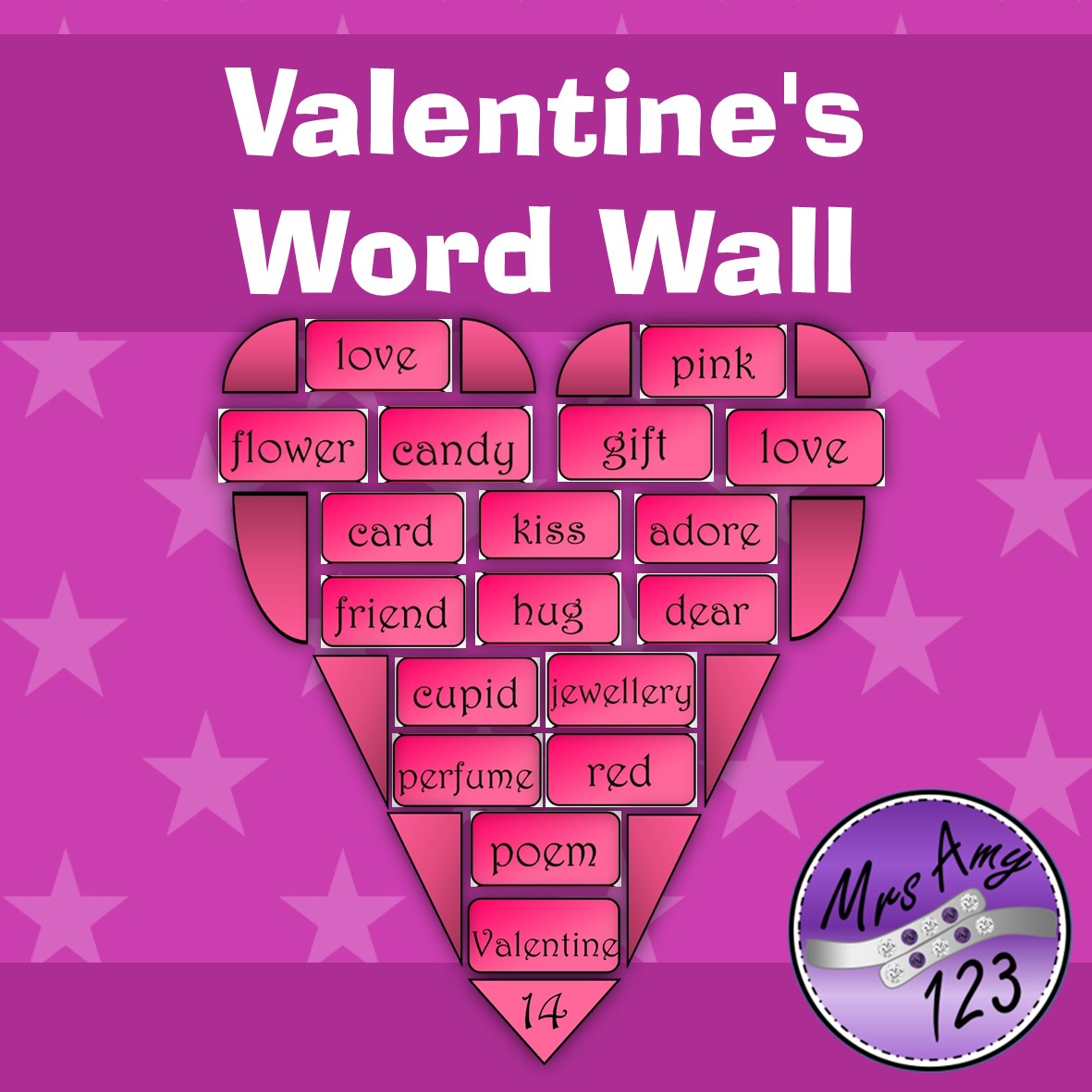
FREE Valentine's Day word wall that makes a heart shape! Available on DBT or TPThttps://www.teacherspayteachers.com/Product/Valentine-Word-Wall-1634903
Subscribe to:
Posts (Atom)